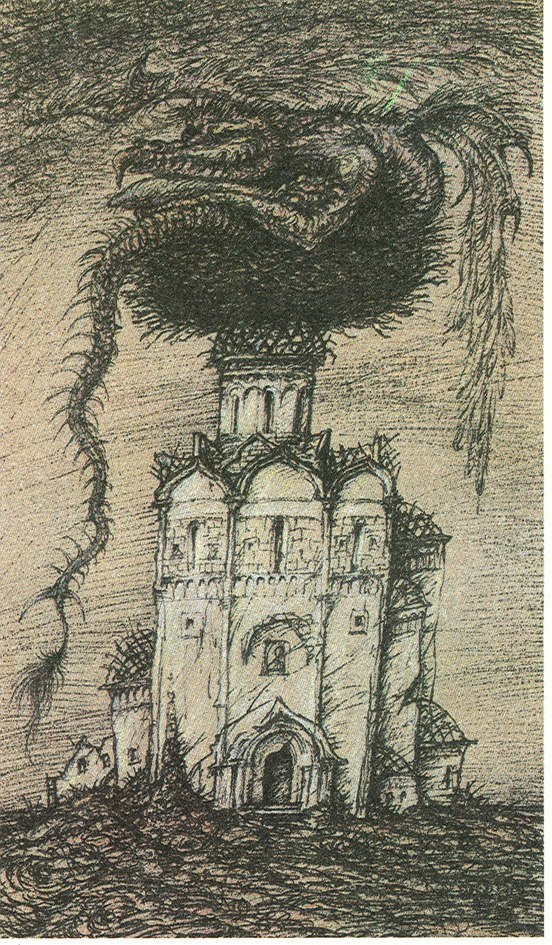
You ever read Wings of Fire? I did. Only ever skimmed council of wyrms but idk I think a TRVE dragongame is probably better served by making you play real Dragons - that is to say, enormous, singular monsters which warp the world around them, ruling as tyrant lizard kings over the bite-sized lesser races. There are no kinds or colors among them, no draconic parody of naked-ape civilization, for no serpent would ever acknowledge the insult of an ordering which declares that they have equals, let alone superiors. For a real dragon, not only are there no friends, there are also no equals or inferiors, no enemies and no friends - there is only lunch, spiky lunch, and emergency rations.
   |
Despite their singularity, dragons are indeed ranked, in size and in maturity. This is incorrectly believed by mortals to be simply a matter of age, of which it sonly partially. In truth, the rank of a dragon is the size of its hoard, and though it takes time to gather there treasure it sleeps on, and time more to sleep and grow amidst its wealth, it is the power of its lucre which drives a dragon to grow, not the passing of the years. Such is this the case that should the hoard be diminished beyond the value required to sustain its level of development, a dragon will shrink back to the level its hoard can actually sustain, losing rank at the same speed at which it was gained. This, of course, explains the famous possessiveness of a dragons, who will tear down kingdoms for a single stolen cup, coin, or ring - the theft of their hoard is the theft of their power, and to allow a thief to live is to invite the loss of all their strength by the grasping hands of the weak things who envy it.
When the King of Heaven granted life to clay and made from it man and beast, he did so with Breath, the holy air he placed in their breast granting life and soul, transforming red mud to red flesh. Dragons were made in much the same way, but when the Queen of the Sea put life into the first wyrm, it was not air which she gave them but Fire. Fire is a consumptive thing, and though it may die down to embers and nurse gently the last scraps of white ash in the fire-pit, when it roars back to full life it will devour entire forests and still ask for more. And so it was that dragons gained their mighty hunger.
While a dragon sleeps, their fire quiets, and they may sleep for centuries without food. When they wake, their fire roars, and they are at once filled with hunger equal to their rank. Every further day they spend awake, and every time they loose their breath does the same. Before they can again sleep, they must fully sate their hunger, and consume additional equal to however much damage they've sustained while awake so that they can heal it as they sleep. One person satisfies one point of Hunger, as does 1 pig, 3 goats, 12 chickens, or 1/5th a cow. Beyond a Hunger limit st by your rank, you will starve to death - this almost never happens, as a dragon's pride and love of life will not let it waste away quietly, and a starving serpent will throw itself against spears to gulp down the men behind them rather than die so ignoble a death.
While you slumber, you dream, and while you dream, you walk the world in lesser form. You are, after all, a king, meant to rule eternal, not a volcano that slumbers, erupts, and sleeps again, silent and forgotten til it sends up fire once more. To work your will, your ned a steward - someone who will bear your mark and reign in your stead. The job requirements are simple, but not easy. You must find a mortal - of one of the finite races who walk on two feat, who hide their unscaled skin with bodies wrapped in rags and raise pointy sticks to hide their absent claws - and get them to drink freely of blood you freely offer. For as long as you and they live, you see through their eyes, hear through their ears, smell with their nose, and speak in their mind, and vice versa. You may maintain only one steward at a time, and when they die you instantly take their max hp as damage - this too works in reverse, but as the steward is near invariably far more fragile than their master this is far more dangerous to them than to you.
Actual campaign frame is that it's domain game like I heard ashes 2 ashes was before the glog server kindly informed me that I had no idea what that game was actually like at all. You have two characters, of course - your dragon and your steward - but you mostly play as the latter, doing ordinary adventure things to gather treasure for your masters hoard, expand their holdings and fortify their lair (for a dragon is most vulnerable inside their nest, where their motion is limited and they my be attacked as they sleep). Your true self, of course, is the dragon, not their finite representative, and your dragon is a meat-powered b-17 in a classical fake-medieval-actually-early-modern-anachronist-pastiche and as such the most terrifying thing in existence, whose chief restrictions are not so much the sort of incapacity for violence which generally limits adventurers but rather the indiscriminate nature of your ultra violence which tends to destroy the things you want to take, in addition to the terrifying, ever-increasing caloric requirements which will have you eat the whole country into a famine if you don't spend 11 months of the year sleeping, and the draconic principle of MAD wherein if you start laying waste to things your rival wyrms care about they'll have to wake up to stop you and dragon fights are just about the worst thing there is.
Additional maybe-ideas;
- TRVE OSR campaign where you start as 0th level flightless fireless soft-skinned wyrmlings escaping the nest at the bottom of your parents dungeon and you have to fight the way out and scour the land for a lair before you starve to death or die of scale-rot or get zweihandred in half by any of the mortal people that knows what happens when a dragon actually gets established.
- classic domain game thing where you start as adults or at least adolescents and pick your lairs off a list, each lair has an associated race of monstrous demihumans, at least one of whom you'll send as a servant and spy to every other dragon in the game like the kakin bodyguard thing in HXH and whenever someone goes adventuring as their steward all the other players play the companions of their respective race as party-members
- there's definitely a billon-year old level 18 dragon somewhere in the setting that hasn't woken up in a hundred million years and is slumbering on a literal mountain nof natural raw gold at the bottom of a cave somewhere and if you wake it up it will literally eat everything on the continent so it can go back to sleep
Table, numbers based on nothing and haven't been play-tested at all - note only the assumption that 1 GP = 1 cow = 32 silver


